Friday, 30 January 2015

Dogs Don’t Want Carbs


What would dogs eat if they could choose for themselves?

That is the question that a recent study tried to answer — at least with regards to the relative concentrations of protein, fat, and carbohydrate in dry, canned, and “home” prepared foods.

Scientists ran three experiments using adultPapillonsMiniature SchnauzersCocker SpanielsLabrador Retrievers, andSaint Bernards (female and male, neutered and intact).

Experiment 1 — the dogs were offered dry foods with variable protein, carbohydrate, and fat levels.

Experiment 2 — the dogs were offered commercially available wet foods with variable protein, carbohydrate, and fat levels.

Experiment 3 — the dogs were offered wet foods with a standard protein level but variable carbohydrate and fat levels. The foods were made from blended, skinless chicken breast, lard, wheat flour, vitamins, and minerals.

In experiment one, the researchers found that the composition of the dry food limited the dogs’ ability to eat what they wanted. To form kibble, dry food requires a relatively high percentage of starch. In essence, the dogs were forced to eat more carbohydrate than they wanted.

When eating wet food, the dogs were better able to select their preferred ratios. To quote:

Dogs in the wet diet treatments composed a diet that had similar protein concentration to those in the dry diet treatment (all dogs fell within the band spanning 25–35% total energy as protein), but was considerably lower in carbohydrate and higher in fat than dogs in the dry diet treatments. This pattern, taken together with the fact that dogs in the dry diet treatment selected intake points that were close to the minimum carbohydrate concentration available to them, suggests that the dry diets are appreciably higher in carbohydrate than the target diet composition. Indeed, even dogs on wet foods appear to have minimized the proportional carbohydrate content of their diet. Overall, these data suggest that the preferred diet composition of the dogs has low carbohydrate:fat balance, with between 25% and 35% of energy contributed by protein.

Experiment three confirmed the nutrient ratios that were revealed in experiment two, while eliminating the chance that the dogs were eating more of one wet food than the other because of differences in palatability.

Taken together, these results suggest that the target diet of dogs in our study consists of approximately 30% of energy from protein, 63% of energy from fat, and 7% of energy from carbohydrate.

Despite this research, I’m not convinced that a diet consisting of 30% energy from protein, 63% energy from fat, and 7% energy from carbohydrate is right for most pet dogs.

These preferences evolved when canine ancestors were extremely active hunters in a feast-or-famine environment. Today’s canine couch potatoes who never miss a meal could get quite fat on this type of diet if their portions aren’t strictly controlled (weight gain was a problem in the study we’ve been talking about). Also, switching to a high fat diet may result in pancreatitis if the transition isn’t done gradually.

That said, I do think it makes sense for owners to look for dog foods that get approximately 30% of their energy from protein and are as high in fat and low in carbohydrates as their dog’s lifestyle can support.

source : http://www.petmd.com/blogs/nutritionnuggets/dr-coates/2015/march/dogs-dont-want-carbs-32542

Wednesday, 21 January 2015

The Special Nutritional Needs of Puppies


Puppies are not simply smaller, younger versions of dogs, in the same way that human babies are not miniature adults. Growth and development is hard work, and special nutrition is required to fuel it.

Also, young animals are especially sensitive to the effects of dietary deficiencies, toxins, and poor quality ingredients, so owners should pay very close attention to what food they feed during a dog’s first year of life.

What are the special nutritional needs of puppies? First, let’s take a look at calories — the gas in the tank, so to speak. Puppies should eat a more calorie-dense food than would be appropriate for a typical adult dog.

A high quality puppy food might have 445 kcal/per cup while an adult food in the same line could have 375 kcal/per cup. That might not seem like such a big disparity, but the extra calories are very important in the long term.

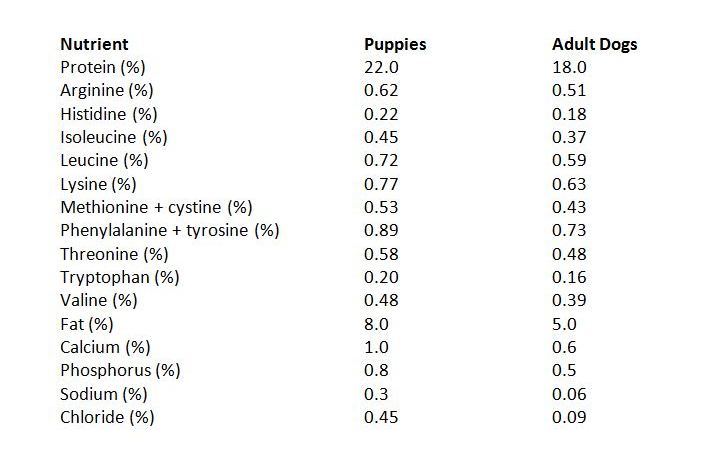
And the differences don’t just stop with calories. Take a look at some of the American Association of Feed Control Officers (AAFCO) minimum nutrient requirement for puppies and adult dogs:

puppy food, breed food, puppy nutrition

You can see that puppies need more of many important amino acids and minerals (and more protein and fat in general) than do adult dogs. Puppies are at risk for nutritional deficiencies if they eat foods designed for adults. Nutrients not regulated by AAFCO are also important.

For example, quality diets contain high levels of certain types of omega 3 fatty acids to promote healthy skin, a glossy coat, and optimize brain and eye development.

Owners of large breed puppies have an additional concern to deal with when picking out a food: developmental orthopedic diseases.

An abnormally rapid growth rate is a major risk factor for hip dysplasia and similar conditions.

Diets designed for large breed puppies should have a lower fat content and therefore a lower caloric density than those meant for small and medium-sized puppies.

Eating a food with too much calcium and phosphorus and a high calcium to phosphorus ratio also increases the odds that a large breed puppy will be afflicted by a developmental orthopedic disease. Therefore, responsible manufacturers carefully balance the amount of calcium and phosphorus in foods designed for these pets.

Whether your puppy is going to grow to be the size of a chihuahua, a mastiff, or somewhere in between, make sure to pick a food that provides perfectly balanced nutrition for this unique time of life, and that it is made from the wholesome, natural ingredients necessary to a lifetime of good health and well-being.

Thursday, 15 January 2015

Feeding Dogs with Intervertebral Disc Disease


Intervertebral disc disease (IVDD) is the scourge  of our “low rider” canine friends, especiallyDachshunds. Those long backs and short legs are caused by chondrodystrophy (atypical cartilage development), a condition that also affects the discs of cartilage that lie between the spine’s vertebrae. Stress causes these abnormal discs to bulge or rupture, which puts pressure on the spinal cord, resulting in pain, weakness, and/or paralysis.

The best way to treat IVDD depends on how severely affected a dog is. Mild to moderate cases (e.g., those with pain and weakness only) will often recover with pain relievers and cage rest followed by a slow return to normal activity.

On the other hand, when a dog’s neurologic function is severely compromised, surgery to relieve pressure on the damaged spinal cord is often necessary. Some dogs fully recover after surgery while others may still have difficulty walking or even remain paralyzed. Unfortunately, chondrodystrophic dogs often have more than one episode of IVDD throughout their lives.

IVDD is a heartbreaking condition. The front end of a severely affected dog is essentially normal, but behind the site of the injury, the dog may not be able to feel, move, or urinate and defecate on its own. While there is nothing an owner can do to treat the underlying chondrodystrophy that leads to IVDD, a couple of recent studies show that paying close attention to what and how much a dog eats goes a long way towards reducing the frequency and severity of these dogs’ back problems.

A paper looking primarily at the effect of body conformation on the likelihood that a dog would develop symptoms associated with IVDD also found a higher risk in overweight dogs, probably because extra body weight increases the stress on intervertebral discs. The authors concluded that dogs at risk for IVDD should be maintained at a “healthy, lean” body condition score of 4-5 out of 9. Take a look at this chart to see what a BCS of 4 or 5 out of 9 looks like.

Another study revealed that a lower body condition score was associated with faster recovery after back surgery (hemilaminectomy). Recovery was defined as the ability to walk without assistance. The dogs included in the project were “7.62 times more likely to have recovered at the initial 3 to 4 week follow-up if they had a BCS of six or less.” The authors concluded that “as weight increased, the time to recovery post hemilaminectomy surgery, also increased.”

I recommend that Dachshunds and other chondrodystrophic dogs (e.g., Beagles, Pekingese, Corgis, and Shih-tsus) eat a diet that is moderate in fat and carbohydrates and relatively high in protein. These characteristics help promote muscle mass while not putting dogs at undue risk for obesity.

Of course, the amount a dog eats also needs to be closely monitored and adjusted to reach or maintain a body condition score of 4-5 out of 9. Nutritional supplements that can help maintain cartilage health (e.g., glucosamine, chondroitin, green-lipped mussels) are also worth considering.

Saturday, 10 January 2015

Does your dog have seasonal environmental allergies?


Like humans, dogs can be allergic to ragweed, grass, pollens, molds and dust mites. Humans’ seasonal environmental allergies are typically identified by sneezing, running nose, and red irritated watery eyes but when a dog is affected by seasonal environmental allergies the typical symptoms are much different. 
What are the signs of seasonal environmental allergies in dogs?
The ESP Test – which stands for Ears, Skin and Paws – is a simple check you can do to determine if your dog is showing symptoms of seasonal environmental allergies.
EarsSee your vet if there’s a strong odour or discharge coming from your dog’s ears, or if it has recurring ear infections. Pawing at its ears or shaking its head may also be signs.
SkinSee your vet if you notice that your dog is itching and scratching, rubbing against furniture to get relief or obsessively grooming. Hair loss, skin lesions and redness are also symptoms.
PawsSee your vet if your dog is excessively chewing at its paws or grooming to the point of removing fur. In fact, itchy paws may be the sign of an allergy – maybe even to the same pollen you are allergic to. Other symptoms include paw discolouration from licking or red/sore paws. 
The good news is you can support healthy skin through proper nutrition.  There are diets available to help support seasonal environmental allergies and other allergies.  The goal of these diets is to increase ceramide production in the skin to create a strong skin barrier.  A stronger, healthier skin barrier can reduce the absorption of allergens. 
source : http://www.petfoodnutrition.com/does-your-dog-have-seasonal-environmental-allergies/